Difference Between Generative AI and Agentic AI with Use Cases
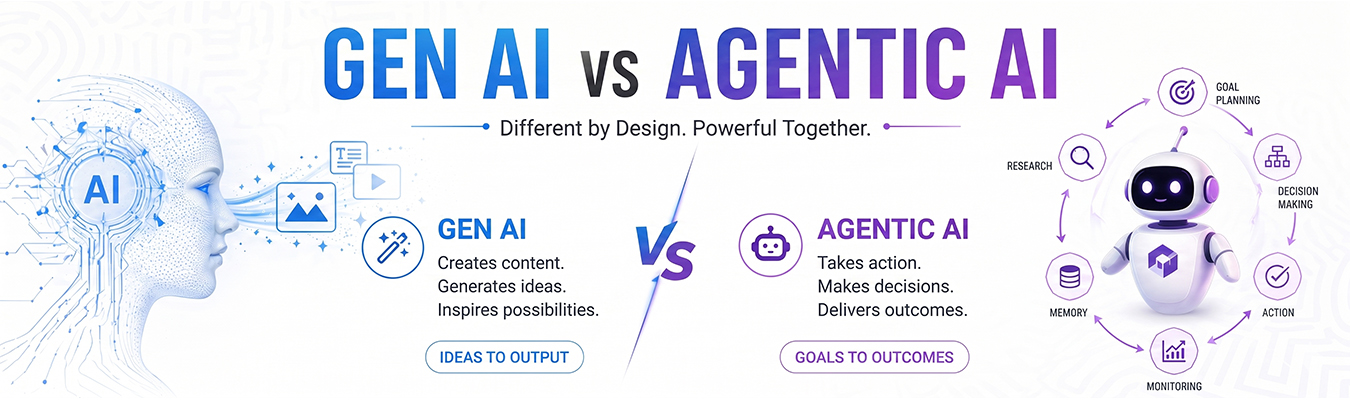
Ever wondered if your AI can do more than just talk? While we’ve all seen chatbots that write poems and summarize reports, a big change is happening. We’re moving from Generative AI to Agentic AI—AI that doesn’t just “think” but actually “acts.”
This shift from Generative AI vs Agentic AI is the key to solving the “GenAI Paradox,” where companies have the tech but aren’t seeing the big return on investment they expected. Understanding the difference between Generative AI and Agentic AI is crucial for unlocking the full potential of AI in your organization. In this blog, we will delve deeper into the differences between Generative AI and Agentic AI, explore their functionalities, and identify real-world use cases across industries.
Beyond Creation: The Essential Guide to Generative AI vs. Agentic AI
The landscape of Artificial Intelligence is undergoing a seismic shift. For the past few years, we have lived in the era of “AI as a Writer,” dominated by the creative prowess of Generative AI. However, as we move into 2026, we are entering the era of “AI as a Worker”—the age of Agentic AI.
Understanding the difference between Gen AI and Agentic AI is no longer just a technical requirement; it is a strategic imperative for any organization aiming to stay competitive. Businesses are realizing that simply generating content is not enough—what they need is an AI system that can plan, execute, and improve over time.
Join our course, What is AI and How It is Transforming Careers in 2026, at TechVibz Academy! Learn how AI is reshaping industries, boosting productivity, and creating new career opportunities. Equip yourself with in-demand skills for the future!
What is Generative AI? (The Creative Architect)
Generative AI refers to AI systems designed to create new content—such as text, images, video, or software code—by learning patterns from massive datasets. These models, primarily powered by Large Language Models (LLMs), are fundamentally reactive. They wait for a human prompt and provide a one-shot response based on their training data.
Generative AI excels at content synthesis and summarization, making it highly effective for applications such as drafting emails, writing essays, creating marketing copy, and generating code snippets. However, despite its creative prowess, Generative AI cannot take actions in the real world. It can generate ideas, but it cannot act on them autonomously.
Key Characteristics of Generative AI:
- Reactive: Responds to user input or prompts.
- Content Creation: Generates text, images, and videos.
- One-time Output: Produces a single result per prompt.
- Limited Autonomy: Requires constant human guidance and input.
What is Agentic AI? (The Autonomous Worker)
Agentic AI represents a new frontier in AI technology. Unlike its generative predecessor, Agentic AI can make autonomous decisions and take actions to achieve specific goals with minimal human intervention. The difference between Generative AI and Agentic AI is often described as a shift from “Output-oriented” to “Outcome-oriented” systems.
For instance, while Generative AI might generate a travel itinerary, Agentic AI will book the flights, check visa requirements, adjust the itinerary in real-time, and even resolve issues such as flight cancellations. In short, Agentic AI doesn’t just provide information—it takes action to deliver results.
Key Characteristics of Agentic AI:
- Proactive: Takes independent actions based on defined goals.
- Autonomous: Operates with minimal human intervention.
- Outcome-Oriented: Focuses on achieving tangible results.
- Learning Capabilities: Adapts strategies based on feedback and changing conditions.
The Core Technical Distinction: The Reasoning Loop
The “magic” of Agentic AI lies in its reasoning loop, a set of processes that allow it to function autonomously.
This loop is typically broken down into four key steps: Perceive, Reason, Act, and Learn.
- Perceive: The agent gathers data from its environment, such as reading a customer email, monitoring a server, or analyzing sensor data in a factory.
- Reason: It processes the data, analyzing the situation against its predefined goals to determine the best course of action.
- Act: The AI executes actions to move toward its goal, using external tools like APIs, databases, web browsers, or connected systems.
- Learn: The agent monitors the results of its actions and adapts its strategies based on new data, improving over time.
This reasoning loop enables Agentic AI to continuously evolve and optimize its actions.
Generative AI vs. Agentic AI: A Comparison Table
| Feature | Generative AI | Agentic AI |
|---|---|---|
| Primary Goal | Content Creation & information Retrieval | Goal Execution & Task Completion |
| Operational Model | Reactive (responds to prompts) | Proactive (initiates actions) |
| Workflow Style | One-shot: Prompt → Output | Iterative: Goal → Plan → Execute → Reflect |
| Autonomy Level | Low; requires constant human guidance | High; operates independently within guardrails |
| Learning Mechanism | Static (post-training) | Dynamic (learns from feedback and environment) |
| Tool Access | Limited; generally self-contained | Dynamic; interacts with APIs, CRMs, and ERPs |
Real-World Use Cases: Generative vs Agentic AI
- Finance
Generative AI: Can summarize lengthy financial reports or market analysis.
Agentic AI: Acts as an “AI Worker” that autonomously coordinates entire audits, gathering documents, validating controls, and pre-populating workpapers, reducing weeks of work to mere hours. - Healthcare
Generative AI: Drafts diagnostic summaries from patient notes.
Agentic AI: Provides continuous real-time patient monitoring, autonomously flagging risks, and even triggering emergency responses, such as dispatching ambulances. - Software Development
Generative AI: Helps write code snippets or assists with debugging.
Agentic AI: Handles the entire Software Development Lifecycle (SDLC), autonomously managing continuous integration, fixing bugs, and executing testing. - Customer Service
Generative AI: Answers simple FAQs or basic queries.
Agentic AI: Resolves complex customer service issues autonomously, from processing refunds to sending confirmation emails and updating account histories—all without human involvement.
How Students Can Leverage Generative AI and Agentic AI in Their Studies and Careers
As AI continues to evolve, students must understand how to use Generative AI and Agentic AI to enhance their academic work and future careers.
1. Enhancing Academic Work with Generative AI
Generative AI can significantly improve productivity in academic tasks. Students can use it for:
- Idea Generation: It can help with brainstorming topics, summarizing research, and providing creative suggestions for papers.
- Writing Assistance: Generative AI can draft essays, assist with grammar checks, and suggest improvements.
- Coding Help: In tech fields, AI can help generate code snippets and debug programs.
By integrating Generative AI, students can save time and enhance the quality of their work.
2. Preparing for Career Opportunities with Agentic AI
As Agentic AI becomes more integrated into industries, students need to understand its potential in task automation and decision-making:
- Task Automation: Learn how AI can autonomously manage tasks like scheduling, customer support, and data analysis.
- Real-World Applications: Exposure to tools powered by Agentic AI—such as chatbots and automation systems—prepares students for future roles in sectors like finance, healthcare, and software Development.
AI in Research and Data Collection
For research-heavy courses, Agentic AI can help:
- Automate Data Collection: It can gather data from databases and online sources, saving students time on large projects.
- Analyze Data: AI can assist in processing and analyzing complex data, providing insights for research papers.
By understanding both Generative and Agentic AI, students can develop skills essential to their careers and academic projects, ensuring they stay ahead in an AI-driven world.
The Future of AI: The Rise of the “Internet of Agents”
By 2028, it’s predicted that 33% of enterprise software will include Agentic capabilities. As organizations move from analyzing data to orchestrating outcomes, the true value of Agentic AI will be realized. These systems will handle more than just routine tasks—they will drive strategic actions, automate processes, and improve decision-making across departments.
Long Story Short
So, are you ready to stop just “prompting” your AI and start “hiring” it? As we move into an era of decentralized “Internet of Agents,” the line between having an assistant and having a digital workforce is blurring.
Generative AI will continue to help you communicate more effectively, but it is Agentic AI that will enable your business to act faster and more efficiently. The future is not just about what AI can say—it’s about what AI can do for you, even when you’re not in the room.
Transform your skills with AI! TechVibz Academy offers comprehensive training programs designed to help individuals and organizations implement AI seamlessly. Contact us to begin your AI journey!