
Generative AI vs Machine Learning: Key Differences
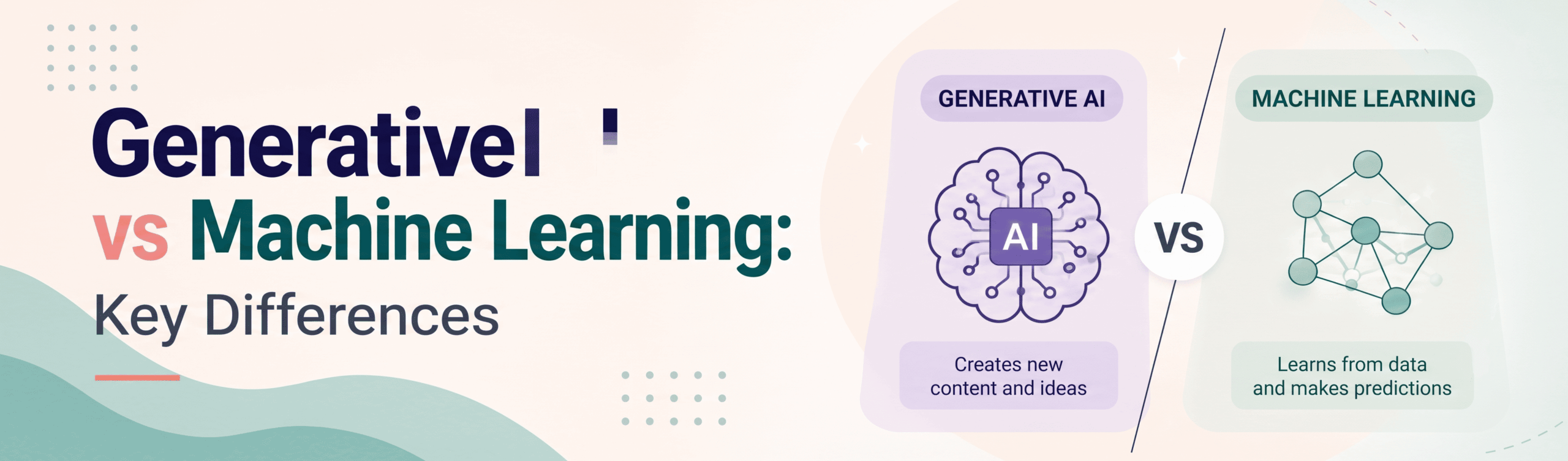
In 2026, the two most popular and common words are “AI” and “Machine Learning”. Not many people get a clear idea about how they are similar or different. AI is a common program everyone is literally dependent on today. From writing a social media caption to generating code to build a product, AI is everywhere. Then what about machine learning when we talk about AI, especially generative AI (that helps create art, write content, etc.). Users across the globe who are looking to expand their career into the world of advanced technology are confused over generative AI vs machine learning.
In this article, the differences and similarities are clearly discussed. From understanding AI to how it differs from machine learning, we explained everything here!
Understanding AI
Artificial Intelligence (AI) is an all-encompassing term. AI means programming computers to behave like a human being with the capability to think or learn. AI systems can be found everywhere: in the voice recognition software in our phones or in the shopping websites’ recommendation algorithms. If you want to learn more about AI, there is an artificial intelligence course where you learn the foundations of AI; from there, you can specialize in the more applied or complex fields of AI like machine learning or generative AI.
What is ML
Machine learning (ML) is a sub-domain of AI where computers learn from data. Unlike traditional programming where computers are given explicit instructions, computers in ML learn from the patterns of the data and can make predictions. An application of ML is the spam filter in email systems. Many people prefer to learn by doing, and this explains why there is a large uptake of machine learning training. These training courses guide participants on the architecture of ML systems and their operation.
What is Generative AI
Generative AI is the subdivision of AI where computers can produce their own data. This includes generating music, text, images, and videos. While traditional AI frameworks only analyze the data, in this type of AI, the computer can synthesize something novel. For example, AI can now write a story or draw a picture for you. This type of AI is believed to give computers the creative capability.
Key Differences
While there is a lot of overlap in the fields of AI, ML, and Generative AI, there are a few things that set them apart. Here’s a simple way to understand how they’re different:
- Purpose: ML mainly focuses on prediction and classification, while Generative AI is focused more on the synthesis of novel data.
- Output: ML and generative AI both produce different types of outputs; ML outputs are mainly numbers or predictions. For Generative AI, these outputs can be in the form of images or texts.
- Example: ML might recognize spam; generative AI might compose the whole email for you.
- Relationship: Generative AI is an application of ML, so they are not separate.
Having this knowledge allows you to determine which AI concepts and related skills you should develop, depending on your interests.
Career Applications
If you enjoy data and numbers, you may find working on projects related to machine learning, data analysis, or ML engineering to be fulfilling career choices. On the other hand, if you enjoy being creative and coming up with new ideas, working on projects related to generative AI, for instance, content creation or prompt engineering, may be good career choices. Many professionals have actually learned both, since both are complementary fields that will be useful to you.
Final Thoughts
Although both machine learning and generative AI are related, they both have their own applications. ML is about teaching machines to understand data, and generative AI is about the creations that can be drawn from the learnt data. With the knowledge of both, a wealth of professional opportunities can be envisaged within the flourishing Industry that is AI.